


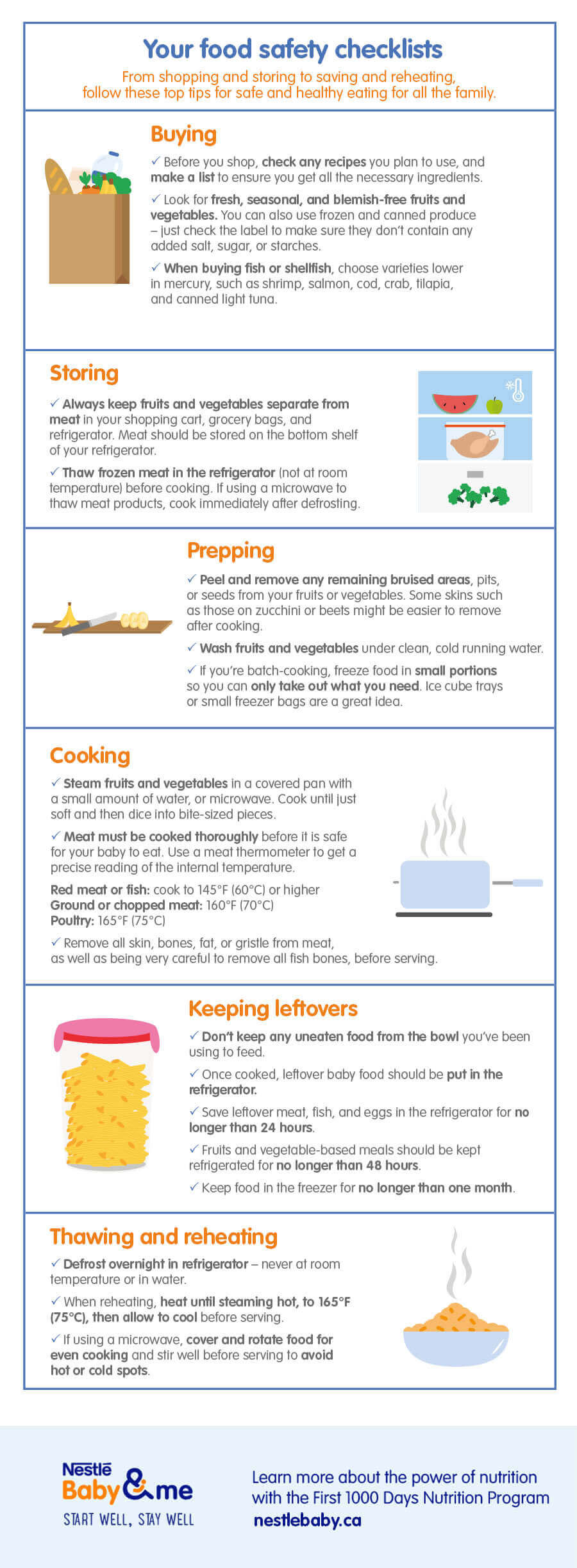
Follow these top tips for safe and healthy eating for the entire family
Sources
https://www.fsis.usda.gov/wps/portal/fsis/topics/food-safety-education/… (Accessed December 21 2017)
Altkorn B, Rider G, Chen X, and Stool D. (2014) Other Significant Hazards: Food-Related Choking. In: Motarjemi Y. (ed.) Encyclopedia of Food Safety, Volume 3, pp. 110-116. Waltham, MA: Academic Press.
Related articles

Benefits of probiotics for babies
This article includes contributions from Dr. Dina Kulik, pediatrician, and Charlotte Geroudet, GD.
5 mins to read

The importance of family mealtimes and letting your baby lead the way
Research has shown that shared family meals—no matter the size of your family—provide benefits for your baby beyond the joy of simply eating dinner together.
3 mins to read

Adventures in feeding: new tastes, new textures, new techniques
Now that your baby is eight to 10 months old, has enjoyed their first tastes, and is becoming more experienced at eating, it’s time to move on to lumpy foods and helping them learn to feed themself
6 mins to read

7 reasons to keep breastfeeding
Breastfeeding beyond 6 months has many benefits for you and your baby. Discover them!
1 min to read

Safe first finger food for babies
By now you've noticed that everything seems to make its way into your little one’s mouth. Once he’s able grasp small objects, eating those little goodies is exactly what he'll try to do.
5 mins to read

How to help your baby learn to like new foods and textures
Did you know? Your baby may need to try some foods and textures several times before she is happy to eat them.
3 mins to read

How to Know if Breastfed Baby is Full
How to Know if Breastfed Baby is Full? The longer a mom breastfeeds, the more she responds to her baby’s signs of fullness.
2 mins to read

This baby poop guide will help you understand the differences between different baby stool colours and consistencies as well as the stools of babies on different diets.
7 mins to read

How to continue your breastfeeding journey
While most women around the world breastfeed their babies in the early months, breastfeeding rates at 12 months of age vary widely. With the Health Canada recommendation to breastfee
2 mins to read

The ins and outs of babies’ digestive system
By Dr. Jeff Habert, family physician
3 mins to read

Your baby’s growing and their digestive system is developing, too. Learn how to switch formulas the right way to support your child’s nutritional needs.
3 mins to read

Your baby is now used to eating solids and may be grabbing at the spoon or picking up food by herself. This means she is ready for more self-feeding, a whole new messy adventure!
6 mins to read

How to prepare and store baby formula
Formula. It’s full of nutrition—but how you prep and store it can serve up some questions, too.
5 mins to read

It’s easy to fall into the habit of offering your baby the same foods every day, especially if you know they’ll happily eat them.
3 mins to read

The way young children are fed may be as important as the food offered
1 min to read

Around six months of age, baby’s evolving needs call for the introduction of foods
1 min to read

3 tips for your baby’s happy, healthy tummy
By Dr. Ted Jablonski, family physician
3 mins to read

Your 5-step guide to eco-shopping
Bringing a baby into this world can make new parents think about the future of the planet, and how they can lessen their impact for generations to come. Here are five ways
3 mins to read

Why your baby needs to eat throughout the day
Did you know? Your baby may need to eat three meals and two mini meals each day.
2 mins to read